
Skip to content
Neundorfer 50 Year Anniversary Logo
Home Knowledge Base US & European Cement Regulation Comparison

US & European Cement Regulation Comparison

Regulatory

On September 9, 2010, new emission standards for hazardous air pollutants (HAPs) from Portland cement kilns went into effect. The new Environmental Protection Agency (EPA) rules, known as PC MACT, have a significant impact on cement production in the U.S. Some in the industry feel the new limits will be very difficult, if not impossible, to meet.

Since the early 2000s, the European Union (EU) has had in place similarly strict emission limits for cement producers. This raises the question: how do EU regulations compare with PC MACT, and what have plants done to meet emission limits?

An apples-to-apples comparison of U.S. and EU cement regulations is difficult because different units of measurement are used. A few examples:

  • In the EU, particulate emission limits are measured based on milligrams per normal cubic meter (mg/Nm3) of gas coming out of the kiln. In the U.S., the measure for PM is pounds per ton (lbs/tn) of clinker.
  • In the EU, mg/Nm3 is also used to measure HCl, while in the U.S. this pollutant is measured in parts per million by dry volume (ppmvd).
  • In the EU, the basis for a œnormal cubic meter is dry gas with 10% oxygen at 0oC. In the U.S., oxygen content is usually standardized at 7%, or sometimes 3%.

Some countries in the Europe set their own emission limits at more stringent levels than the EU’s specifications. Example: the EU-specified limit for PM10 is 20 mg/Nm3, but Finland’s limit for this same pollutant is 10 mg/Nm3. Some EU countries have other relatively stringent requirements for compliance, such as Germany where continuous emissions monitoring systems (CEMS) are mandatory to measure mercury, PM, HCl, NOx and SO2.

Table 1 below shows emission limit ranges for different pollutants, set at different levels by countries in the EU.

https://www.neundorfer.com/wp-content/uploads/2016/06/cement-comparison-table-1.png

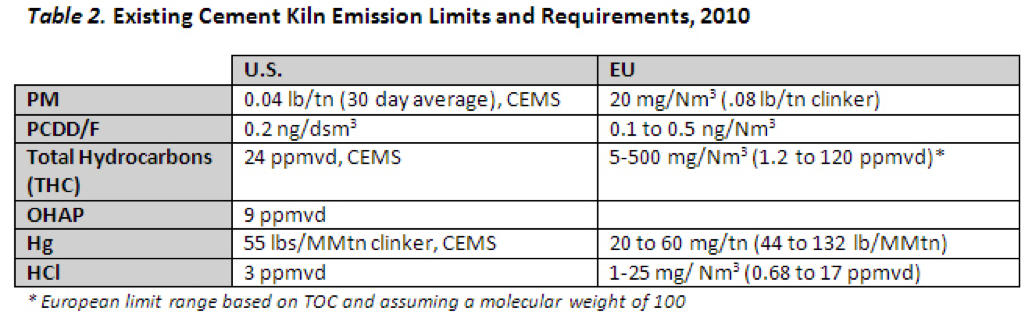
Some of the numbers in Table 1 are based on measured values, while others are emission limits. In Table 2 below, lower ranges from Table 1 are used to compare EU regulations with U.S. PC MACT.

https://www.neundorfer.com/wp-content/uploads/2016/06/cement-comparison-table-2.png

From Our Optimized Insights

Latest Insights

  • News Article

    2025: A Year of Milestones, Momentum, and Gratitude

    As we reach the close of 2025, I want to take a moment to reflect on the progress we’ve made together during a year filled with meaningful achievements and important transitions. First, I’m proud to share that we completed another year with zero safety incidents. Safety is foundational to…

  • News Article

    Celebrating 50 Years of Neundorfer!

    This year marks a milestone: Neundorfer’s 50th Anniversary. For half a century, we’ve been driven by innovation, collaboration and a commitment to helping our partners solve complex challenges in smarter, more sustainable ways. In August, we gathered with employees, partners, and friends to celebrate this achievement. It was…

  • News Article

    2024 in Review: Success, Sustainability, and Milestones

    2024 in Review: Success, Sustainability, and Milestones As the year draws to a close, I want to take a moment to reflect on the successes we’ve achieved and the milestones we’ve reached together. This has been a remarkable year—one that saw us successfully complete numerous projects, welcome…