
Skip to content
Neundorfer 50 Year Anniversary Logo
Home Knowledge Base Why Precipitator Performance Degrades (Even When Everything Looks Fine)

Why Precipitator Performance Degrades (Even When Everything Looks Fine)

Maintenance

Precipitators are exposed to a steady accumulation of wear mechanisms—ash loading, temperature cycling, vibration, corrosive environments, and repetitive rapping.

What makes this challenging is that most performance issues don’t start with a clear failure. They develop gradually, often going unnoticed until performance is already impacted.

Understanding where degradation occurs, and how it shows up in operation, is the first step toward staying ahead of it.

Common Degradation Mechanisms

These are the primary areas where we consistently see deterioration over time:

Ash accumulation and re-entrainment

Deposits on collecting surfaces, frames, hoppers, and gas passages reduce collection efficiency. Ineffective removal can also lead to re-entrainment—where collected ash is released back into the gas stream.

Collecting plate distortion and misalignment

Thermal cycling, ash loading, and mechanical contact can cause plates to warp or shift. This does not significantly impact gas flow patterns, but it does affect plate-to-discharge electrode clearances—often resulting in higher sparking and reduced power levels.

Discharge electrode distress

Wear, corrosion, misalignment, or loosened supports reduce corona generation, limiting particle charging and overall performance.

Rapper system wear and maladjustment (motor-driven systems)

Shaft wear, linkage looseness, hammer/anvil deterioration, and drive issues reduce impact effectiveness—leading to poor ash removal and increased re-entrainment.

Top-rapped system degradation (electric and pneumatic rappers)

Electric rappers can experience coil fatigue, reduced stroke energy, and timing drift. Pneumatic systems may suffer from inconsistent air pressure, valve issues, and air quality problems. In both cases, inconsistent impact leads to ineffective cleaning or excessive re-entrainment.

Insulator contamination and tracking

Ash, moisture, or chemical deposits reduce dielectric performance, increasing the risk of electrical leakage and flashover.

Support-frame and internal steel corrosion

A chemically aggressive environment leads to metal loss, section thinning, and potential structural concerns.

Hopper plugging and discharge restrictions

Bridging, rat-holing, or valve issues prevent effective ash removal and allow material to accumulate inside the precipitator.

Air inleakage and casing leakage

Inleakage changes gas conditions and volume, reducing efficiency and creating instability.

High-voltage connection degradation

Deterioration of bus components and connections impacts stable energization and overall reliability.

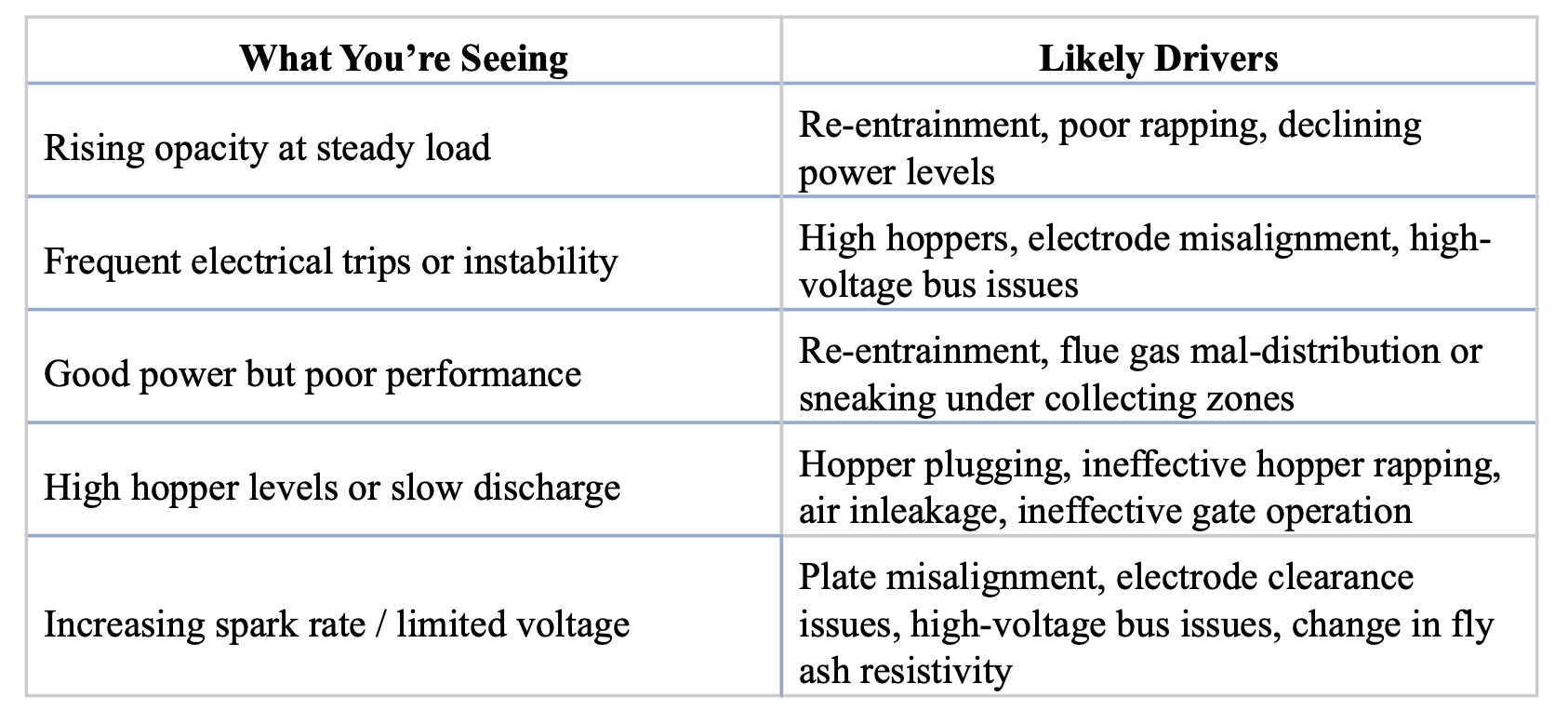
What You Might Be Seeing (and What’s Likely Driving It)

This is where these issues become operational:

https://www.neundorfer.com/wp-content/uploads/2026/05/Screen-Shot-2026-05-29-at-3.27.55-PM.png

Where to Start (High-Impact Checks)

When performance starts to drift, focus on a few high-leverage areas:

  • Electrical performance: Are you achieving expected voltage and current levels—or are you spark-limited?
  • Ash removal effectiveness: Are rappers actually clearing surfaces, or just operating?
  • Gas path integrity: Is there inleakage or bypass affecting conditions inside the precipitator?
  • Mechanical alignment and condition: Are plates and electrodes maintaining proper clearances?

The Hardest Problems to Catch

Some of the most impactful issues are also the least obvious:

  • Gradual loss of rapping effectiveness
  • Plate misalignment affecting electrical clearances (not visually obvious)
  • Electrical limitations masked by “acceptable” operation
  • Slow increases in air inleakage over time These don’t show up as failures—they show up as lost performance margin.

What This Means for Your Operation

If your precipitator has been in long-term baseload service, some level of degradation is almost always present, even if the system appears stable. The key questions are:

  • Are issues being identified early?
  • Are you addressing root causes—or reacting to symptoms?
  • Do you know where performance margin is being lost?

A structured approach, combining inspection, operating data review, and performance analysis, helps prioritize what actually matters and avoid unnecessary work.

Ready to Get Ahead of Precipitator Degradation?

Neundorfer’s team has spent decades helping operations teams identify performance issues before they become costly problems. Whether you’re seeing early warning signs or looking to build a more proactive maintenance approach, we’re here to help.

Contact us today to talk through what you’re seeing or download our free Precipitator Diagnostic Guides to give your team a fast, reliable diagnostic reference for the issues covered here.

From Our Optimized Insights

Latest Insights

  • News Article

    2025: A Year of Milestones, Momentum, and Gratitude

    As we reach the close of 2025, I want to take a moment to reflect on the progress we’ve made together during a year filled with meaningful achievements and important transitions. First, I’m proud to share that we completed another year with zero safety incidents. Safety is…

  • News Article

    Celebrating 50 Years of Neundorfer!

    This year marks a milestone: Neundorfer’s 50th Anniversary. For half a century, we’ve been driven by innovation, collaboration and a commitment to helping our partners solve complex challenges in smarter, more sustainable ways. In August, we gathered with employees, partners, and friends to celebrate this achievement.

  • News Article

    2024 in Review: Success, Sustainability, and Milestones

    2024 in Review: Success, Sustainability, and Milestones As the year draws to a close, I want to take a moment to reflect on the successes we’ve achieved and the milestones we’ve reached together. This has been a remarkable year—one that saw us successfully complete numerous…