

Skip to content
Neundorfer 50 Year Anniversary Logo
Home Knowledge Base Year-End Checklist: Preparing Your Electrostatic Precipitator for Peak Performance in 2026

Year-End Checklist: Preparing Your Electrostatic Precipitator for Peak Performance in 2026

Maintenance

The annual year-end shutdown isn’t just a time to fix what’s broken; it’s your biggest opportunity to guarantee your Electrostatic Precipitator (ESP) runs perfectly for the entire next year. Your goal should be Performance-Based Maintenance (PBM): a smart strategy focused on restoring your ESP to be better than its original working condition.

For Neundorfer, this means making the biggest performance jump while keeping costs down, using your own operational data to guide every decision.

Building the Smart Foundation

A successful outage starts with a rigorous planning phase. You need to gather intelligence from every corner of your facility to see the full picture.

Intelligence Gathering:

  1. Define Your Mission: Are you doing a standard check-up, or are you hunting down a specific, nagging problem? A clear goal saves significant time and money.
  2. Talk to Everyone: Get input from your electrical, mechanical, and ash handling teams.
  3. Get Your Baseline Data: Before shutting down, record all current operational settings.
  4. Safety First: Fans off, power locked out. No exceptions.

The Brain and the Powerhouse: Controls and Power Systems

Your Transformer-Rectifier (T/R) sets and Automatic High Voltage Controls (AHVCs) are the engine and brain of the ESP. Keeping them accurate is critical.

T/R Sets and Controls Health Check:

  1. Physical Inspection: Check T/R sets for fluid leaks, ensure grounds are solid and they are securely bolted down, and check the high voltage bus connections. Verify that all safety locks, interlocks and ground switches are working smoothly.
  2. Stop the Guesswork: Verify that the settings in the control match the T/R nameplates Many performance problems come from the controls getting the wrong information. A common issue is an inaccurate settings. The control system may inadvertently be set to operate below the actual output capacity of the T/R set.
  3. The Diagnostic Clue: A common issue is with secondary voltage (Kv). If the system is running at strangely low voltage, but the primary power looks normal, you probably have a calibration issue.
  4. Recalibrate with Confidence: Use a known formula to calculate the estimated secondary voltage and compare it to what the control system says it is. If they don’t match, you must recalibrate. This step is vital to optimize performance and prevent damage to the T/R set from power surges. Click here for the formula.

The Deep Internal Dive: What a Good ESP Inspection Should Reveal

A thorough internal inspection is the most effective way to understand the true condition of your precipitator. Electrical data will point you toward a problem, but only a structured internal review will show you exactly what’s causing it. Here’s a simplified framework to guide your next outage.

Start with a Clean ESP

A meaningful inspection requires clean internals. Dust buildup hides misalignment, damage, broken components, and chronic mechanical issues. Cleaning first ensures you can clearly see the conditions affecting performance.

Verify Mechanical Systems

Before focusing on plates and wires, check the support systems that keep the ESP healthy:

  • Rappers: Make sure mechanical energy is transferring effectively. Ash buildup on plates or wires often indicates weak or inconsistent rapping.
  • Seals & Purge Air: Air leaks or failed purge fans allow ash and moisture to contaminate insulators, leads to corrosion, creating electrical instability.
Inspect Plates and Electrodes

A quick but focused look at the collecting plates and discharge electrodes can reveal the issues most responsible for chronic performance problems:

  • Warped plates
  • Bent or broken electrodes
  • Misalignment
  • Corrosion

Any of these will distort the electrical field and reduce overall efficiency.

Prioritize What to Fix Now vs. Later

Not every issue requires immediate repair. Create a simple list that separates:

  • Critical fixes needed to restore stable operation
  • Repairs to schedule for the next planned outage
  • Items to monitor between now and the next inspection

This helps the team make smart decisions without overextending the outage window.

Finish With an Electrical Confirmation

After completing internal work, perform a V-I Curve test to ensure no new grounds were introduced and that electrical performance reflects the mechanical improvements.

If you want the full inspection guidance, including what to look for, what to measure, and how to document conditions, you can find it here: Precipitator Inspection Guide

https://www.neundorfer.com/wp-content/uploads/2025/11/5.webp

Request your Precipitator Diagnostic Guides: quick-reference resources to identify common ESP and control system issues, understand likely causes, and take the right corrective action.

The 3-Step V-I Curve Verification: A Simple Way to Confirm Outage Success

After a maintenance outage, one of the most reliable ways to confirm that your precipitator is healthy, and that your work made a measurable difference, is by performing a V-I Curve Verification.

What’s a V-I Curve?

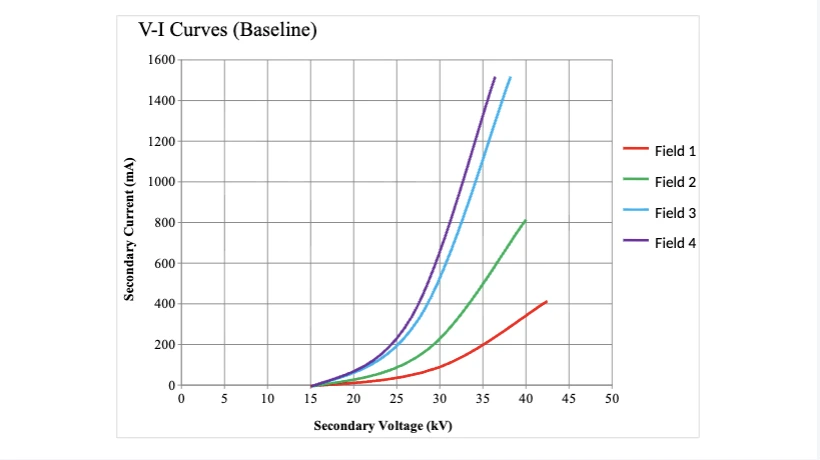
A V-I curve is a controlled test of a single transformer-rectifier (T/R) set. In simple terms, it measures how much voltage and current the electrical field can carry as the power increases.

Why it matters:

  • As voltage rises, the T/R set begins generating corona, which actually charges the dust.
  • The shape of the curve shows how freely the electrical field can operate and whether anything is limiting performance.
  • A clean, properly aligned precipitator will produce a smooth, strong curve.
  • A “flat,” noisy, or distorted curve can point to issues like misaligned electrodes, ash buildup, cracked insulators, or close clearances.

Because the test maps the gives you an electrical inside look to the precipitator, it is one of the fastest ways to confirm the quality and durability of outage work not to mention a great diagnostic tool.

https://www.neundorfer.com/wp-content/uploads/2025/11/Screen-Shot-2025-11-17-at-11.16.58-AM.webp
Step 1: Pre-Startup Verification

Before energizing the equipment, run the heaters and purge air for at least one hour to dry the insulators. Then bring power up slowly, section by section.

What success looks like:

  • The system reaches its secondary current or voltage limits smoothly.
  • Sparking is minimal and occurs later than before the outage.
  • The initial curve is noticeably stronger than your pre-outage benchmark.
Step 2: Process Stabilization Check

Once the unit has run long enough for a light ash layer to form and the process is stable, perform a V-I curve for each T/R set.

Why this matters:

  • This confirms that your post-startup tuning, voltage control, rapping, clearances, was correct under real operating conditions.
Step 3: The 1-Month Reliability Metric

After about a month of continuous operation, run your final comparison curve.

Two outcomes to watch for:

  1. Sustained improvement: The curve remains strong compared to pre-outage data. This signals a successful, durable maintenance effort.
  2. Rapid performance decline: If the curve drifts back toward pre-outage levels, you likely have a chronic mechanical issue, such as a close clearance, misaligned discharge electrode, or dirty insulators, that needs attention before it impacts compliance.

A Note on Modern Controls

Most modern control systems can automatically generate V-I curves and store them for comparison. Refer to your system’s operation manual for instructions on how to access these tools.

Need help interpreting your curves?

We can help.

Our team can walk you through how to run the test, compare your data, and identify whether your precipitator is showing healthy electrical performance, or signaling deeper issues that need to be addressed.

Just reach out, and we’ll review your curves with you.

From Our Optimized Insights

Latest Insights

  • News Article

    2025: A Year of Milestones, Momentum, and Gratitude

    As we reach the close of 2025, I want to take a moment to reflect on the progress we’ve made together during a year filled with meaningful achievements and important transitions. First, I’m proud to share that we completed another year with zero safety incidents. Safety is foundational to…

  • News Article

    Celebrating 50 Years of Neundorfer!

    This year marks a milestone: Neundorfer’s 50th Anniversary. For half a century, we’ve been driven by innovation, collaboration and a commitment to helping our partners solve complex challenges in smarter, more sustainable ways. In August, we gathered with employees, partners, and friends to celebrate this achievement. It was…

  • News Article

    2024 in Review: Success, Sustainability, and Milestones

    2024 in Review: Success, Sustainability, and Milestones As the year draws to a close, I want to take a moment to reflect on the successes we’ve achieved and the milestones we’ve reached together. This has been a remarkable year—one that saw us successfully complete numerous projects, welcome…